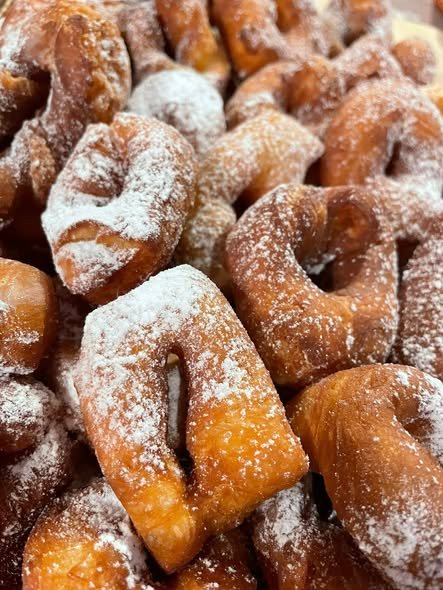
Delicious Bugnes (Traditional French Fried Pastries)
Bugnes are light, golden French pastries traditionally enjoyed during Carnival and Mardi Gras, especially in the Lyon region. Somewhere between a doughnut and a crisp fritter, bugnes can be soft and pillowy or thin and crunchy, depending on the style. This recipe focuses on the soft, tender version, delicately scented with citrus and finished with a generous dusting of icing sugar.
Perfect with coffee, tea, or hot chocolate, these pastries are simple to make and irresistibly delicious while still warm.
What Are Bugnes?
Bugnes are a classic French fried dough made from a lightly enriched dough containing eggs, butter, and milk. Unlike yeasted doughnuts, bugnes are subtly sweet and delicately flavoured, relying on technique rather than heavy sugar for their appeal. Traditionally, families would gather to make large batches at home, filling the kitchen with the aroma of frying dough and citrus zest.
Ingredients
For the Dough
-
2½ cups (315 g) plain flour
-
¼ cup (50 g) caster sugar
-
Pinch of salt
-
Zest of 1 lemon or orange
-
3 eggs
-
60 g butter, melted and cooled
-
2 tablespoons milk
-
1 tablespoon orange blossom water or rum (optional)
For Frying and Finishing
-
Neutral oil (sunflower or vegetable), for deep frying
-
Icing sugar, for dusting
Method
1. Make the Dough
In a large bowl, combine the flour, sugar, salt, and citrus zest. Make a well in the centre and add the eggs, melted butter, milk, and orange blossom water or rum if using.
Mix until a soft dough forms, then turn out onto a lightly floured surface. Knead gently for about 5–7 minutes, until smooth and elastic. The dough should be soft but not sticky. Add a small amount of flour if needed.
2. Rest the Dough
Shape the dough into a ball and place it in a clean bowl. Cover with a cloth or plastic wrap and let it rest at room temperature for at least 1 hour. This step is essential for tender bugnes and easier rolling.
3. Roll and Shape
After resting, divide the dough into two portions. Roll one portion out very thinly on a floured surface (about 2–3 mm thick). Thin dough creates lighter, more delicate bugnes.
Cut the dough into rectangles or diamond shapes, approximately 8–10 cm long. Cut a small slit in the centre of each piece and gently pull one end through the slit to create a twist.
4. Heat the Oil
Heat oil in a deep saucepan or fryer to 170–175°C (340–350°F). The oil should be hot enough to puff the dough quickly without browning too fast.
5. Fry the Bugnes
Fry the bugnes in small batches, turning once, for about 1–2 minutes per side until lightly golden and puffed. Do not overcrowd the pan.
Remove with a slotted spoon and drain on paper towels.
6. Finish and Serve
While still warm, generously dust the bugnes with icing sugar. Serve immediately for the best texture and flavour.
Tips for Perfect Bugnes
-
Roll the dough thin: This is key to light, delicate pastries
-
Resting matters: Don’t skip the resting time—it improves both texture and flavour
-
Control oil temperature: Too hot and they burn; too cool and they absorb oil
-
Dust just before serving: For the prettiest finish
Variations
-
Crispy bugnes: Roll the dough extra thin and fry slightly longer
-
Vanilla bugnes: Add 1 teaspoon vanilla extract to the dough
-
Citrus sugar: Mix icing sugar with a little lemon zest for extra aroma
-
Spiced version: Add a pinch of cinnamon or nutmeg
Storage
Bugnes are best eaten fresh on the day they are made. However, leftovers can be stored in an airtight container at room temperature for up to 24 hours and lightly re-dusted with icing sugar before serving.